Why Your Thermostat Says Cooling But the House Heats Up
Why Your Thermostat Says Cooling But the House Heats Up
When a thermostat display shows that the system is cooling, but the indoor temperature keeps rising, the problem is usually deeper than a setting mistake. In Phoenix, AZ, this pattern often points to a real air conditioning failure under extreme desert load. It is one of the most common triggers for Emergency AC Repair calls during summer across Maricopa County. A house in Arcadia, Biltmore, Ahwatukee, Desert Ridge, or Maryvale can go from uncomfortable to unsafe fast when the AC appears to be running but the living space keeps heating up.
Phoenix is not a mild cooling market. It is climate zone 2B under ASHRAE 169, with design cooling temperatures that typically fall in the 110 to 117 degree range depending on elevation and location. On west-exposed equipment pads near I-10, Loop 202, or the South Mountain area, the actual temperature around the outdoor condensing unit can climb to 130 or even 140 degrees in peak afternoon sun. That kind of sustained heat changes how AC components fail. It is why Emergency AC Repair in Phoenix is often about electrical stress, airflow collapse, refrigerant issues, or severe condenser coil fouling rather than a simple thermostat replacement.
Day & Night Air Conditioning, Heating & Plumbing has worked in Phoenix since 1978 from its headquarters at 3669 E La Salle St in 85040. The company handles Emergency AC Repair across Phoenix and the surrounding Valley with Arizona ROC C-39 air conditioning and refrigeration licensure, EPA Section 608 certified technicians, and R-454B transition training for the post January 1, 2026 refrigerant standard. The diagnostic pattern behind a thermostat that says cooling while the house heats up is familiar across older ranch homes in 85018, newer subdivisions in 85050, and family homes in 85044 and 85048.
What that symptom usually means in a Phoenix home
If the thermostat says cooling, it means the control is calling for lower temperature. It does not mean the system is actually removing heat from the house. The thermostat is only sending a signal. The rest of the system still has to respond correctly. In a Phoenix AC system, that means the air handler indoors has to move enough air across the evaporator coil, the outdoor condenser has to reject heat to the outside air, the compressor has to circulate refrigerant, and the electrical components have to keep both sections operating together.
When any part of that chain breaks, the thermostat can continue to show cooling while the house gets warmer. In many Emergency AC Repair calls, the blower motor inside the air handler is running, so air still comes from the vents, but the outdoor unit has stopped doing the actual heat rejection work. In other cases, the outdoor unit runs but the indoor coil is frozen, so the system cannot move heat. Sometimes both sections run, but a low refrigerant charge or a failing compressor means almost no cooling capacity is left.
This symptom matters more in Phoenix than in many other cities because homes absorb heat aggressively. Solar gain through west-facing glass, attic heat buildup, leaky ductwork, and long afternoon run times make any loss of cooling capacity show up quickly. A house near Camelback Mountain or in the Biltmore 85016 area with older ductwork can gain temperature even faster if the system is already losing supply air into a superheated attic.
Why this issue shows up so often during Emergency AC Repair calls
Emergency AC Repair in Phoenix peaks when systems are under maximum heat stress. That usually means June through September, with additional failures during monsoon season. One of the most shareable but overlooked local facts is that monsoon dust can reduce condenser performance by 15 to 25 percent after a haboob event if caliche fines pack into the outdoor coil. The thermostat still calls for cooling. The fan may still spin. But the condenser coil can no longer release heat effectively, so the house temperature rises anyway.
That is one reason Emergency AC Repair calls after dust storms are so common in North Phoenix, Paradise Valley Village, and South Mountain neighborhoods. The outdoor unit often looks normal from a distance. Up close, the coil surface is blocked with fine desert dust that acts like insulation. Capacity drops, head pressure climbs, and the system may shut off on thermal overload or keep running with very weak cooling.
Another common cause is run capacitor failure. The run capacitor is the cylindrical electrical component inside the outdoor condensing unit that stores and releases the energy pulse needed to keep the compressor and fan motor operating correctly each time the AC cycles on. Phoenix heat shortens capacitor life dramatically. The component may test within range in spring, then fail in July after repeated starts in 115 degree conditions. A failed run capacitor can leave the outdoor fan or compressor unable to start even though the thermostat is still requesting cooling.
The failure points technicians look for first
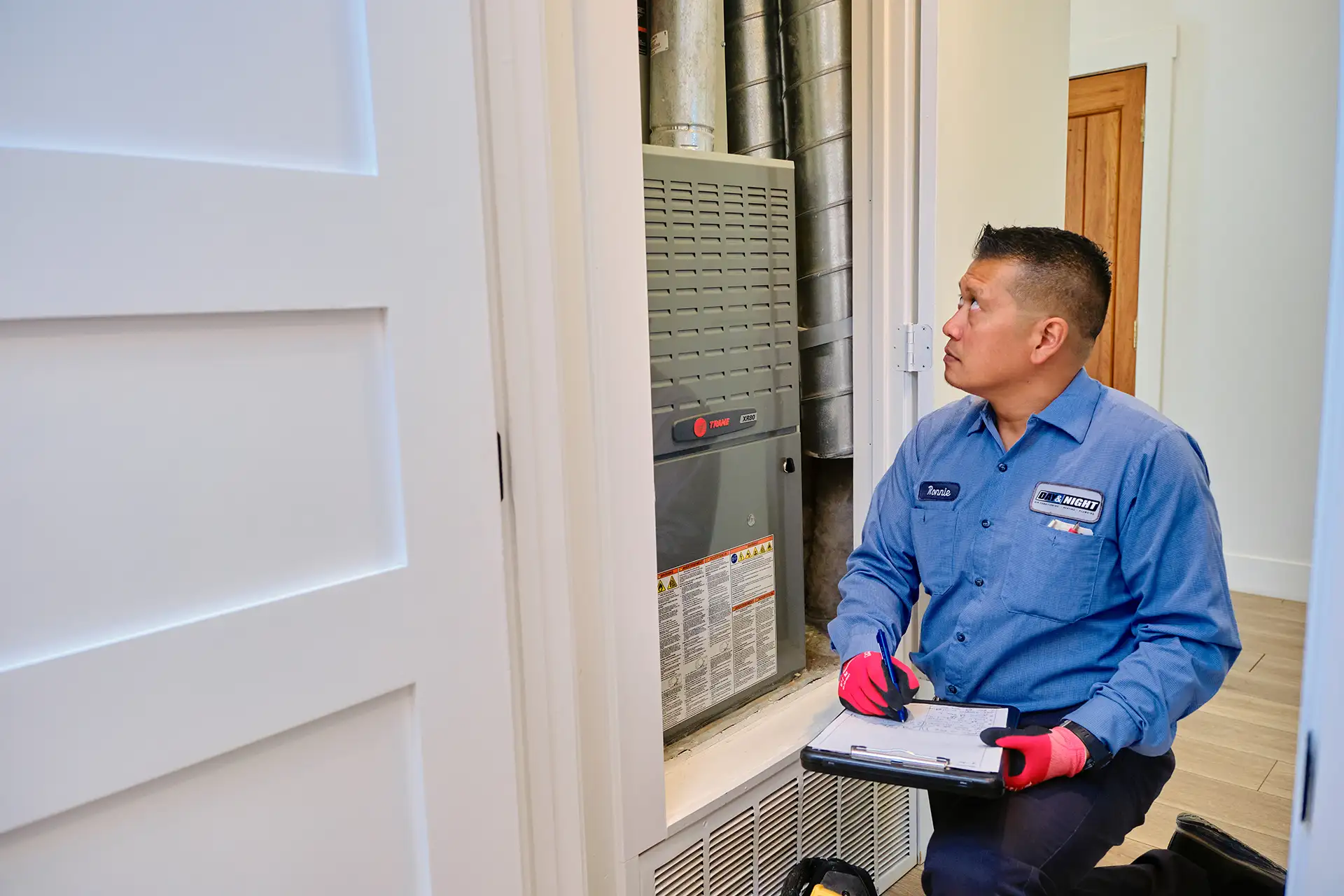
In a real Emergency AC Repair diagnosis, the most likely failure points are not treated as guesses. They are checked in sequence. The thermostat signal is verified first. Then the indoor and outdoor sections are evaluated separately. In Phoenix, the symptoms often narrow the search quickly.
- Run capacitor failure, which can stop the compressor or outdoor fan from starting under heat stress
- Contactor failure, which is the electrical switch that brings high voltage power to the outdoor unit when the thermostat calls
- Condenser coil fouling from monsoon dust, cottonwood debris, or neglected maintenance
- Low refrigerant charge from a leak at the evaporator coil, TXV valve connection, or line set
- Indoor airflow failure from a clogged filter, frozen evaporator coil, blocked drain safety switch, or blower motor problem
Each of those problems can create the same homeowner-facing symptom. The thermostat still says cooling. The house still gets hotter.
When the outdoor unit is the real problem
Many Phoenix households assume the thermostat is defective because the display looks normal while the home feels worse by the hour. In a large share of Emergency AC Repair cases, the thermostat is doing exactly what it should. The outdoor unit is where the failure sits.
The outdoor unit contains the compressor, condenser fan motor, contactor, capacitor, and condenser coil. The compressor is the heart of the cooling cycle. It pumps refrigerant so heat collected indoors can be released outside. If the compressor does not start, the house will not cool. If it overheats and locks out, the indoor blower may continue moving air that feels room temperature or warm. That can make the problem feel especially confusing. People hear the system running, yet the home keeps climbing from 78 to 84 to 89.
The contactor is another high-failure part in Phoenix. It is the electrically controlled switch that closes when the thermostat calls for cooling. Over time, the metal contact surfaces pit and burn from repeated cycling. In severe cases they weld or fail to close fully. That leaves the thermostat calling for cooling with no reliable power delivery to the outdoor section. A proper Emergency AC Repair diagnosis checks voltage across the contactor and confirms whether it is pulling in correctly under load.
Condenser coil condition matters just as much. Phoenix dust, landscaping debris, and pet hair can block the coil fins. Once airflow across that coil drops, the system cannot reject indoor heat efficiently. Pressures rise, capacity drops, and the compressor works harder than it should. This is a field reality in neighborhoods from Sunnyslope 85020 to Ahwatukee Foothills 85044, especially where the outdoor unit sits near gravel landscaping and afternoon sun.
When the indoor section is creating the illusion of cooling
Some systems do have the outdoor unit running, but the cooling still fails because the indoor side has lost airflow. The evaporator coil is the cold indoor coil inside the air handler or furnace cabinet. House air passes over it so heat can be absorbed. If airflow drops too far, the coil temperature can fall below freezing and ice forms across the surface. Once that happens, airflow gets worse, cooling output collapses, and the thermostat keeps calling while the space heats up.
A dirty air filter is a frequent trigger. Filter choice matters in Phoenix. A MERV 8 filter is a basic residential filtration level. MERV 11 and MERV 13 filters catch smaller particles, but if the duct system or blower is not designed for the extra resistance, airflow can suffer. That is why experienced technicians do not treat filter upgrades as automatically better. A system that already has marginal airflow can move from acceptable to frozen coil conditions after one overly restrictive filter change.
The blower motor can also fail partially. It may run at reduced speed, overheat, or cut in and out. In those cases, occupants sometimes still feel air at the vents, but not enough air volume to cool the house. That distinction matters during Emergency AC Repair. Air movement alone is not proof of proper cooling operation.
Condensate safety devices can create similar confusion. The condensate drain line carries water away from the indoor coil. In Phoenix, algae and debris can clog the drain. If a float switch trips, the system may shut down the outdoor unit to prevent overflow while leaving part of the control system active. The thermostat still indicates cooling demand, but actual cooling stops.
Refrigerant problems are different in 2026 than they were a few years ago
Low refrigerant charge remains a major cause of poor cooling and repeated Emergency AC Repair calls. Refrigerant is the heat transfer fluid inside the AC system. If the charge drops because of a leak, the system may cool weakly at first, then freeze the evaporator coil, then stop cooling almost entirely. A leak is never fixed by adding refrigerant alone. The leak source has to be identified and addressed.
For Phoenix homeowners, the repair decision now sits inside a changing refrigerant market. New R-410A system manufacturing ended on January 1, 2026 under the EPA SNAP transition framework. New equipment is moving to R-454B, an A2L mildly flammable refrigerant with a global warming potential of 466 compared with 2,088 for R-410A. Existing R-410A systems can still be serviced, but the economics are shifting. When an older system in Encanto or Camelback East develops a coil leak, the discussion around Emergency AC Repair may include whether it makes more sense to repair the current equipment or plan for replacement before refrigerant and component costs climb further.
That does not mean every R-410A issue requires replacement. It does mean the diagnostic conversation has to be grounded in system age, compressor condition, leak location, repair history, duct performance, and the actual thermal load of the house. In Phoenix, that evaluation is more important because undersized or oversized systems fail differently under desert conditions.
Improper system sizing can make this symptom worse
Some homes call for Emergency AC Repair because a component failed. Others call because the system was never well matched to the house. Phoenix is full of systems sized by square footage rather than Manual J Residential Load Calculation under ACCA Standard 1. That shortcut misses roof orientation, window exposure, insulation level, infiltration, occupant load, duct location, and actual design conditions in Maricopa County.
An oversized system short cycles. It starts and stops too often, which increases wear on capacitors, contactors, and compressors. An undersized system can run nearly nonstop and still lose ground in afternoon heat. Either condition can create the impression that the thermostat is wrong when the deeper issue is system design. In Desert Ridge 85050 and newer developments along Loop 101, that shows up in homes with large west-facing glass. In Arcadia 85018 and Biltmore 85016, it often combines with aging ductwork and attic leakage.
A striking Phoenix field reality is that older mid-century homes with original duct systems can lose 35 percent or more of conditioned air before it reaches the rooms. When that happens, the thermostat may accurately call for cooling, the equipment may produce some cooling, and the house can still heat up because the supply air is being dumped into an attic that is far hotter than the living space.
Why one room feels cooler while the rest of the house bakes
Another pattern seen during Emergency AC Repair is uneven cooling. The hallway near the thermostat may feel tolerable, but bedrooms or bonus rooms become unbearable. This often points to airflow distribution rather than thermostat failure. Leaking ductwork, crushed flex duct, closed dampers, disconnected boots, or a blower struggling against high static pressure can all create major room-to-room differences.
Homes in older parts of Phoenix often show this pattern first in back bedrooms with west exposure. The thermostat satisfies the small central area around it, but the rest of the home gains heat faster than the system can deliver conditioned air. During a service call, measuring temperature split alone is not enough. Static pressure, duct condition, blower performance, and supply temperatures at multiple registers have to be part of the evaluation if the complaint is that the thermostat says cooling while the house keeps heating.
What changes during a true emergency in Phoenix
In a moderate climate, delayed AC service is inconvenient. In Phoenix, it can become a health problem the same day. That is why Emergency AC Repair has a different urgency here, especially for households with infants, elderly residents, medical conditions, or upper-floor bedrooms that trap heat overnight. A home that reaches the mid 90s indoors after sunset is not just uncomfortable. It can become dangerous fast.
During the hottest parts of summer, same-day response matters most in zip codes where older equipment is common and insulation levels are inconsistent, such as 85033 in Maryvale, 85020 in Sunnyslope, and 85018 in Arcadia. But the issue is not limited to older homes. Newer two-story houses in Ahwatukee East 85048 or North Phoenix can build heat rapidly if the outdoor unit fails and solar load continues all afternoon.
Emergency conditions also spike after power disturbances during monsoon storms. A surge event can damage capacitors, contactors, boards, or compressors. When the utility power returns, the thermostat may resume calling for cooling, but the equipment may no longer respond correctly. That is another common reason a homeowner sees a normal thermostat display while the house temperature drifts upward.
How a real diagnostic process separates guesswork from repair
A credible Emergency AC Repair process in Phoenix should not revolve around swapping parts until something works. The system has to be tested under operating conditions. That starts with thermostat verification and power checks, then moves to the indoor and outdoor equipment. The run capacitor should be tested with a capacitance meter, not judged by appearance alone. Voltage and amperage readings should be compared to expected operation. The contactor should be inspected for pitting, burning, and proper voltage drop. Refrigerant charge should be evaluated using superheat and subcooling methods where applicable, not by pressure alone.
The TXV valve, which stands for thermostatic expansion valve, also deserves attention in some systems. It meters refrigerant into the evaporator coil. If it sticks or feeds improperly, the system can show poor cooling, erratic pressures, or coil icing. Compressor condition also matters. A compressor that has been overheated repeatedly because of low refrigerant, dirty coils, or chronic undersizing may still run, but with weak pumping ability. That can make the system look alive while delivering very little real cooling.
Electrical diagnostics matter even more in Phoenix because extreme ambient heat changes operating loads. A capacitor or fan motor that seems acceptable on a mild morning can fail by late afternoon. That is why experienced local technicians look at the whole operating context, including recent monsoon dust, filter condition, attic temperature, and whether the system is struggling hardest after 3 PM.
How Phoenix housing stock shapes the diagnosis
Phoenix is not one uniform service environment. A ranch home near the Camelback Corridor with original sheet metal ductwork and aging insulation presents a different cooling profile from a stucco home in a master-planned community off Loop 202. Yet both can generate the same complaint. The thermostat says cooling. The house gets hotter.
In Arcadia and Biltmore, the common pattern is older ducts, weaker attic sealing, and legacy systems that may have been replaced without correcting airflow. In Ahwatukee and Desert Ridge, the issue is often long run times, zoning imbalance, or electrical stress on equipment exposed to full afternoon sun. In commercial light-duty spaces near Phoenix Sky Harbor International Airport or along I-17, rooftop packaged units face similar heat rejection challenges, especially when maintenance has slipped and condenser coils are packed with dust.
This is where local experience matters. Phoenix equipment does not fail the same way as equipment in a coastal or moderate climate. The heat load is harsher. The dust load is harsher. The recovery window after a failure is shorter because the structure itself continues to gain heat all day.
Repair today or replacement soon
Some Emergency AC Repair situations end with a focused repair and years of service left in the system. Others reveal a unit near the end of its economic life. The distinction usually comes down to four factors.
- Age of the equipment and whether it uses legacy R-410A
- Condition of the compressor, evaporator coil, and condenser coil
- History of repeated electrical or refrigerant repairs
- Whether the home was ever sized correctly with Manual J and served by sound ductwork
If replacement enters the discussion, Phoenix homeowners should understand the current market. New split systems in the Southwest must meet 14.3 SEER2 and 11.7 EER2 minimums for systems under 45,000 BTU. New equipment is built around the R-454B transition. For qualifying heat pump installations, APS Cool Rewards can reach up to $2,000, SRP HVAC rebates can reach up to $1,500 in qualifying cases, and the federal Inflation Reduction Act Section 25C credit can add up to $2,000 annually for eligible heat pumps through 2032. That means some Maricopa County households evaluating a failing AC can stack meaningful incentives if replacement is the better path. Day & Night also provides free estimates on new HVAC system installations, financing through approved lenders, and a 10-year parts and labor warranty on qualifying new installations.
Why homeowners across Phoenix keep seeing this exact symptom
The reason this complaint appears so often is simple. It is the symptom produced by many different failures, and Phoenix exposes those failures quickly. A thermostat can only request cooling. It cannot create it. Once a system loses airflow, refrigerant charge, compressor function, condenser capacity, or electrical continuity, the display can stay normal while the living space loses the battle against desert heat.
That is why the issue shows up from North Central Phoenix to Encanto, from homes near Piestewa Peak to subdivisions off US 60 and Loop 101. The common thread is not the thermostat brand. It is the gap between cooling demand and actual system capacity under severe local conditions.
Day & Night Air HVAC contractors Maricopa County Conditioning, Heating & Plumbing has spent more than 40 years diagnosing that gap in Phoenix and Maricopa County. The company has served the Valley since 1978, carries Arizona ROC C-39 and ROC C-37 licenses, and maintains 24/7 emergency service capability with same-day service availability for urgent calls. The team includes EPA Section 608 certified technicians, R-454B transition trained personnel, and NATE-certified technicians where applicable. Those credentials matter because a thermostat that says cooling while the house heats up is rarely a surface problem. It is a system problem.
Why Phoenix homeowners call Day & Night for Emergency AC Repair
For households facing this problem now, the need is usually immediate. Day & Night Air Conditioning, Heating & Plumbing provides Emergency AC Repair across Phoenix, AZ and the surrounding Maricopa County service area, including Arcadia, Biltmore, Ahwatukee, Desert Ridge, Sunnyslope, Maryvale, and nearby communities along I-10, I-17, Loop 101, and Loop 202. The company has operated locally since 1978 from 3669 E La Salle St in Phoenix 85040 and holds Arizona ROC C-39 air conditioning and refrigeration licensure. Technicians are EPA Section 608 certified, trained for the 2026 R-454B refrigerant transition, and backed by upfront flat-rate pricing given in writing before repair work begins. Day & Night maintains a 4.9 star Google rating across 9,400+ verified reviews, offers 24/7 emergency dispatch, same-day service when available, and next-day installation on qualifying replacement systems. For a Phoenix home where the thermostat says cooling but the house keeps heating up, Day & Night can be reached at (602) 492-9656 to schedule Emergency AC Repair.
Phoenix, AZ 85040